Land cover data in flood mitigation analyses:
In FastFlood, land cover data plays a key role in flood simulation, as it directly influences the surface friction of the terrain, a crucial factor for the dynamics of water flow in the watershed. This friction depends on the type of land cover, and it is accurately captured using the Manning's friction coefficient, combined with the Darcy-Weisbach friction law in the Saint-Venant equations used for flood modeling.
The Manning’s friction coefficient (Manning’s n) is a parameter used to model the soil's resistance to water flow. This value depends on the type of land cover. For example, a forest has higher friction due to its dense vegetation, while agricultural land has less friction, allowing water to flow more easily.
The Manning’s n values for each type of land cover are based on the Copernicus WorldCover 2021 dataset and values derived from scientific literature. This dataset provides a precise global land cover classification, allowing flood simulations to be adjusted appropriately based on the terrain type.
Copernicus WorldCover 2021 Dataset
WorldCover 10m is a land cover dataset developed by the European Space Agency (ESA) as part of the Copernicus program. This dataset provides a global land cover map with a spatial resolution of 10 meters, enabling very detailed information about Earth's surface.
It is based on satellite images from Sentinel-1 and Sentinel-2 satellites. These images allow precise classification of land cover into 11 different classes, including forests, agricultural lands, urban areas, water bodies, and more.
Manning’s n Values Based on Land Cover
Each land cover type has a specific Manning’s n value, allowing for more accurate simulation of how water interacts with the land surface. Below are the default Manning’s n values used in FastFlood for different land cover types:
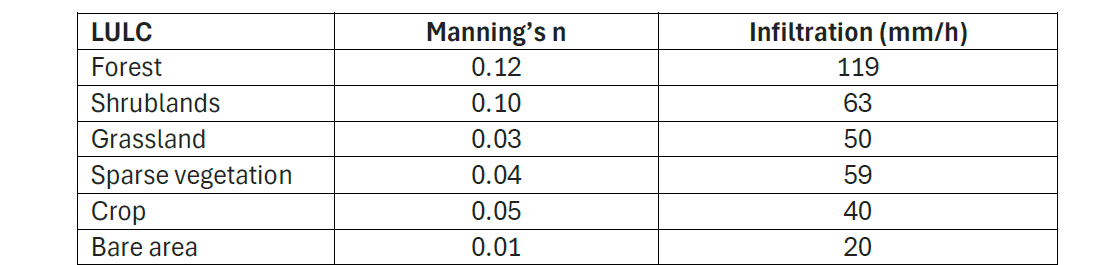
For example: Forests and mangroves, which have dense vegetation, have a high friction coefficient, meaning water will move more slowly through these areas.
Urban areas and bare soil, with less friction, allow water to flow more quickly.
These variations in surface friction are essential for predicting how water will interact with different terrain types and for accurately simulating flooding in different areas.
Bibliography
Copernicus DEM. 2019. Agencia Espacial Europea (ESA). | https://doi.org/10.5270/ESA-c5d3d65
Effect of Vegetation Cover Types on Soil Infiltration Under Simulating Rainfall. 2013. Nature Environment and Pollution Technology (NEPT). | https://neptjournal.com/upload-images/NL-42-2-2.pdf
Referencies
Análisis comparativo de la infiltración del suelo bajo tres tipos de uso del suelo. | https://doi.org/10.2991/iceesd-18.2018.322