Future climate to model floods:
The system has the capability to model future flood scenarios by integrating future precipitation data to simulate how flooding might change due to climate change. Future precipitation scenarios are based on the NASA Earth Exchange Global Daily Downscaled Projections (NEX-GDDP), a high-resolution, globally scaled climate projection dataset.
The system uses the NEX-GDDP dataset to provide future climate projections derived from CMIP6 climate models. These models are based on climate change projections for a range of possible futures, spanning from sustainability-focused pathways (SSP1) to those with high dependence on fossil fuels (SSP5), reflecting different levels of global cooperation, policy responses, and technological development.
Key features of the NEX-GDDP dataset:
- Precipitation projections cover the entire globe, with a spatial resolution of 0.25 degrees (~25 km).
- The data includes historical records from 1950 to 2100, enabling analysis of current and future conditions under different climate scenarios.
- The dataset covers various Shared Socioeconomic Pathways (SSPs), which represent different possible socioeconomic and political futures.
To calculate future design storms, an extreme value analysis was applied to annual maximum precipitation data. This analysis helps identify the most extreme rainfall events that could occur in the future under different climate scenarios.
- Precipitation is modeled for durations ranging from 3 hours to 240 hours, covering a wide range of possible rainfall events.
- Return periods for rainfall are calculated from 5 to 50 years, allowing modeling of both common and less frequent extreme events.
Analysis segmentation: To represent current climate and reduce bias, the reference period is set between 2015 and 2035. Future periods (2025–2100) are divided into three analysis segments: 2030, 2050, and 2080. These segments allow calculation of precipitation intensity multipliers that reflect changes in rainfall intensity compared to the reference period.
Precipitation intensity multipliers: Changes in precipitation intensity due to climate change are represented by multipliers in the FastFlood model. These multipliers are calculated as the change in precipitation intensity between the future period (e.g., 2050) and the reference period. For example, the precipitation multiplier for 2050 represents the change in rainfall intensity compared to the reference period (2015–2035).
The following figure shows global precipitation changes for a 10-year return period, one-day rainfall event under the SSP2 4.5 scenario in 2080.
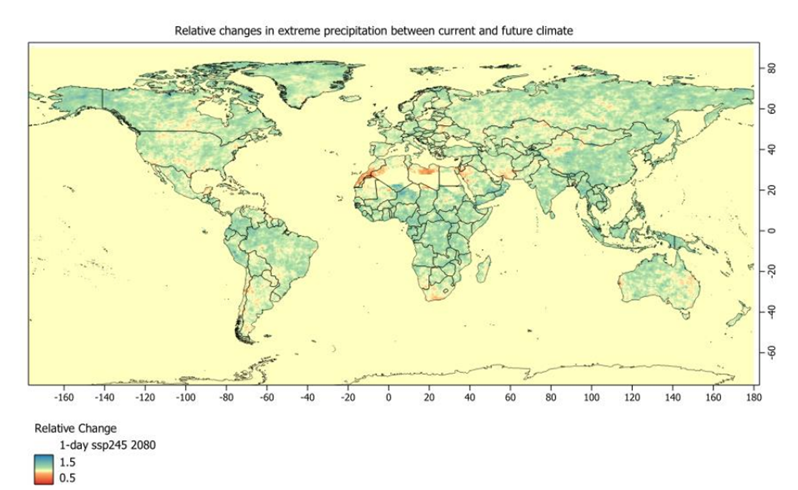
Precipitation multipliers are crucial for modeling the impact of extreme rainfall under future scenarios. By incorporating these changes in precipitation intensity into flood simulations, the system can project how flooding might vary in the future due to climate change.
The FastFlood future climate model helps users to:
- Anticipate the impact of extreme rainfall and flooding in the future.
- Simulate flood scenarios under different future climate conditions.
- Evaluate the effectiveness of flood mitigation solutions in a changing climate.
Bibliography
NASA Earth Exchange Global Daily Downscaled Projections (NEX-GDDP-CMIP6). 2024. NASA. | https://www.nccs.nasa.gov/services/data-collections/land-based-products/nex-gddp-cmip6
Referencies
Caribbean Handbook on Risk Management | https://charim.net/